Pizza vending machine technology explained for commercial buyers
How Does a Pizza Vending Machine Work?
A modern pizza vending machine combines temperature-controlled food storage, a customer ordering interface, payment hardware, automated product handling, a programmed cooking or heating stage, a dispensing area, sensors and—on connected systems—remote monitoring. The exact sequence depends on whether the machine works with fresh dough, refrigerated prepared pizza, or frozen stock-and-bake inventory.
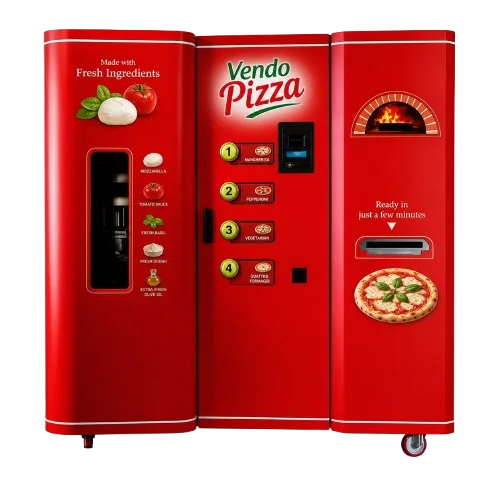
How does a pizza vending machine work in simple terms?
The customer chooses a pizza and completes payment. The machine checks that the selected item is available, retrieves or prepares the product, moves it into a programmed oven or heating chamber, transfers the finished pizza to the collection area, and records the sale. On connected models, the system can also update stock, transaction data, temperature readings, and machine alerts for the operator.
From customer selection to hot pizza
The 8-Step Pizza Vending Machine Process
Most stock-and-bake systems follow a sequence like the one below. Fresh-dough machines can add preparation stages before cooking, while refrigerated and frozen machines usually retrieve a prepared product from storage.
Customer selects a pizza
The menu displays the products currently offered, their prices, and any available choices.
Payment is authorised
The configured payment system confirms the transaction before the machine commits the selected product to preparation.
The controller confirms stock
The machine identifies the correct storage position and verifies that the selected product is available.
The pizza is retrieved or prepared
A tray, lift, robotic handler, conveyor, or fresh-preparation mechanism moves the product toward the cooking system.
The cooking cycle starts
The controller runs the program associated with that product, oven, and machine configuration.
The pizza moves to collection
After cooking, the machine transfers the product into a protected dispensing or pickup area.
Inventory and transaction data update
Integrated systems can deduct the item from stock and create a completed transaction record.
Operator data refreshes remotely
Supported systems can remotely send sales, stock, temperature, and device information to the management platform.
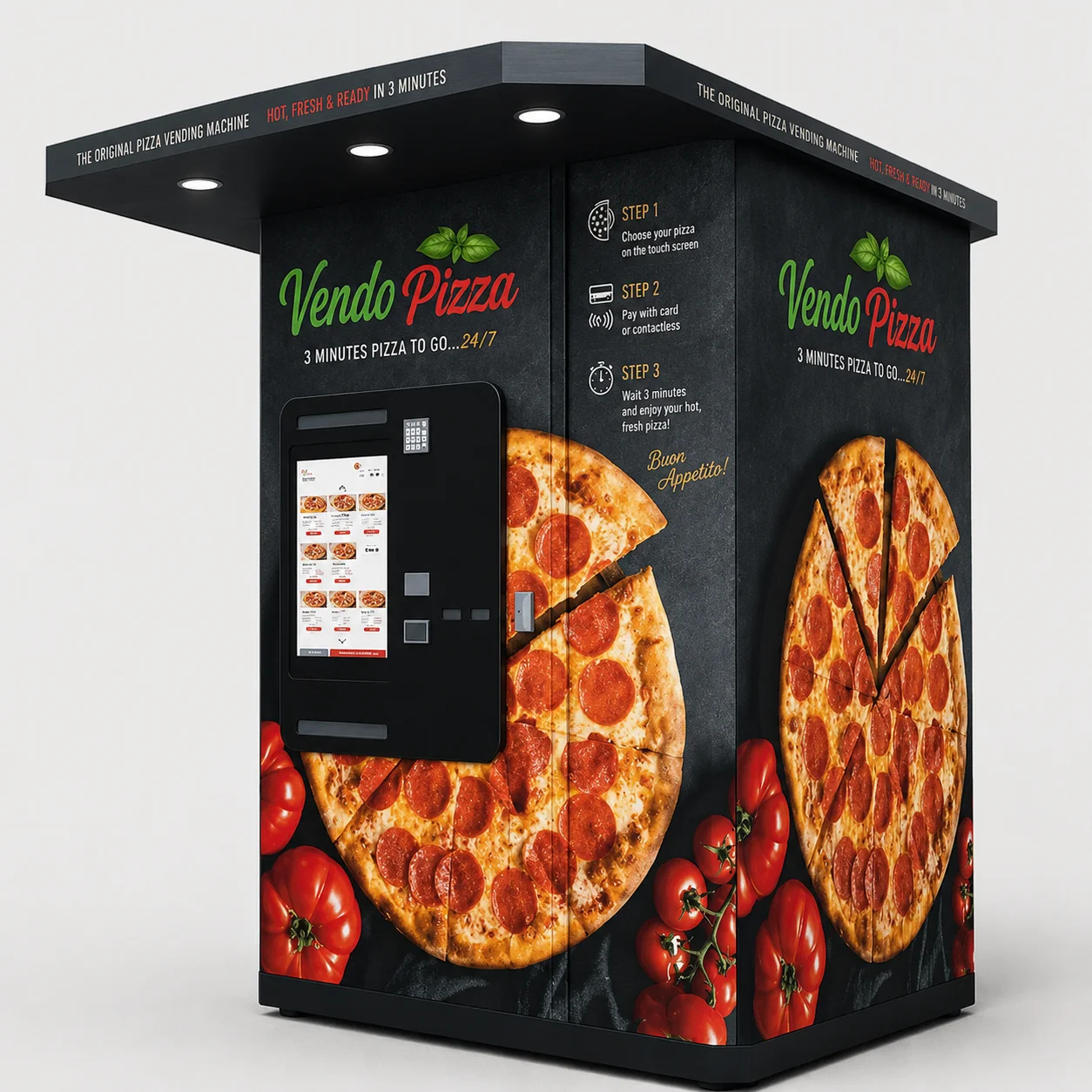
The anatomy of a commercial machine
What Is Inside a Pizza Vending Machine?
A pizza vending machine is not one mechanism. It is a group of subsystems coordinated by a controller. A failure in storage temperature, product movement, the oven, payment, or connectivity can affect the customer transaction differently.
Touchscreen or selection panel
Displays products, prices, availability, payment instructions, and order progress. Some connected systems support remote menu or price changes.
Cashless payment terminal
Processes supported cards, contactless payments, and mobile wallets through the selected merchant/acquirer arrangement.
Temperature-controlled storage
Holds ingredients or prepared pizzas under the conditions required by the exact food workflow.
Retrieval and transfer mechanism
Moves the selected product between storage, preparation, oven,n and pickup. Designs can use trays, lifts, conveyors, or robotic handling.
Oven or heating chamber
Runs a product-specific program using the heating technology designed into the model.
Pickup or dispensing bay
Receives the finished product and provides a controlled customer handoff.
PLC or embedded controller
Coordinates motors, temperatures, timers, sensors, doors, safety states, cooking programs, and transaction logic.
Temperature and position sensors
Provide information about storage conditions and the location or state of moving components.
SIM, Wi-Fi or Ethernet
Provides connectivity for supported payment and remote-management functions.
Three workflows that should not be confused
Fresh-Dough, Refrigerated and Frozen Pizza Vending Technology
Two machines can look similar from the outside while using very different food processes internally. Storage, cleaning, replenishment, product handling, and oven programming all change with the workflow.
| Technology factor | True fresh dough | Refrigerated fresh-bake | Frozen stock-and-bake |
|---|---|---|---|
| What is loaded? | Ingredients, dough components or prepared recipe elements. | Prepared pizzas stored chilled. | Prepared pizzas stored frozen. |
| Before the oven | Dough forming or additional preparation can occur inside the machine. | A chilled prepared pizza is retrieved. | A frozen prepared pizza is retrieved. |
| Cold-chain focus | Ingredients and recipe components. | Refrigerated prepared food. | Frozen prepared food. |
| Automation complexity | May include more internal food-preparation stages. | Storage-to-oven transfer. | Freezer-to-oven transfer. |
| Cleaning workload | Can involve more food-contact preparation components. | Storage, transfer, oven and pickup areas. | Frozen storage, transfer, oven and pickup areas. |
| Commercial comparison | Compare Fresh vs Frozen pizza vending machines | ||
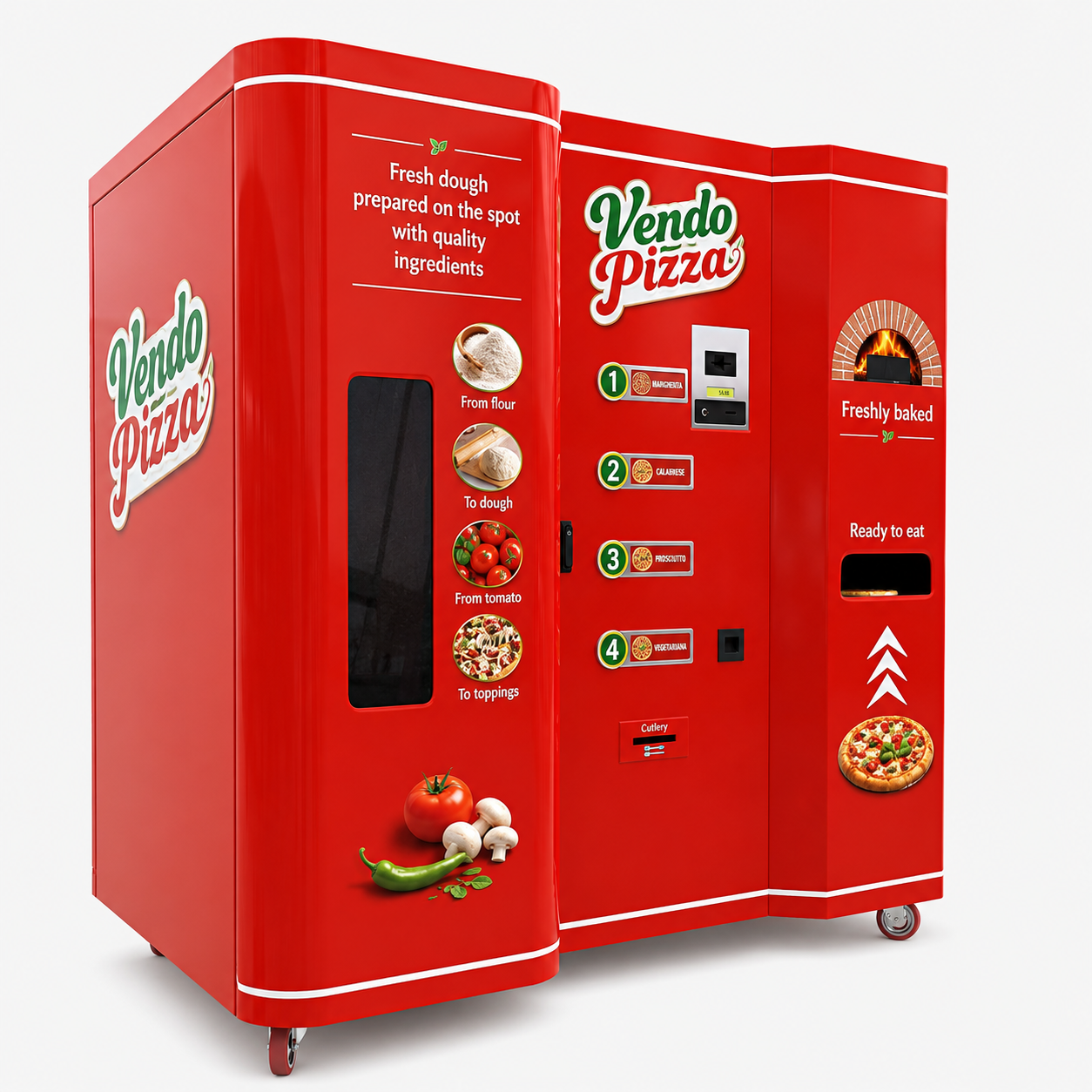
The difference is not theoretical. Let’s Pizza’s current model comparison shows earlier generations using freshly kneaded dough, while its Gen 3 specification lists refrigerated dough options. That is why buyers should verify the exact model generation rather than assume that every machine sold under the same brand uses the same food process.
Food preservation before the sale
How Does a Pizza Vending Machine Store Pizza Safely?
Temperature-controlled storage is part of the food-safety system, but the machine does not remove the operator’s responsibility for production, transport, loading, stock rotation, cleaning, and response to temperature problems.
Temperature control
Refrigerated and frozen configurations use sensors and control logic to maintain the storage compartment. The correct set point must be based on the actual food and machine requirements.
Product position and stock map
The controller needs to know where each pizza is stored so the correct product can be selected and moved after payment.
Cold-chain continuity
The machine cannot correct unsafe transport or loading. Product handling before the machine must remain part of the operator’s food-safety plan.
The oven is only part of the result
How Does a Pizza Vending Machine Cook the Pizza?
Cooking performance depends on the pizza, storage conditions, oven design, energy distribution, program timing, and product geometry. That is why there is no universal cooking time or temperature that applies to every machine and every pizza.
Product-specific cooking profiles
A machine can associate a pizza with a specific heating cycle. If thickness, topping weight, recipe, or storage state changes, the cooking result should be checked again.
Different heating technologies
Commercial systems can use convection, infrared, microwave-assisted, or proprietary combinations. The exact oven technology should be confirmed from the model documentation.
Physical fit is not enough
A pizza may fit inside the rack but still cook poorly if the crust, topping load, packaging, or frozen state is not compatible with the transfer and heating system.
The order is a controlled transaction
How Do Touchscreen Ordering and Cashless Payments Work?
The customer sees a simple screen, but the machine must coordinate product availability, the payment terminal, and the preparation sequence so that it does not start cooking an item that cannot be sold or delivered correctly.
Menu and availability
The interface shows the products and prices. Integrated systems can use stock information to help prevent sold-out products from remaining available.
Payment authorisation
The terminal processes supported payment methods through the configured merchant/acquirer relationship. Supported cards and wallets vary by market and setup.
Transaction record
Connected platforms can report transactions by machine, product and time, helping operators investigate demand and payment issues.
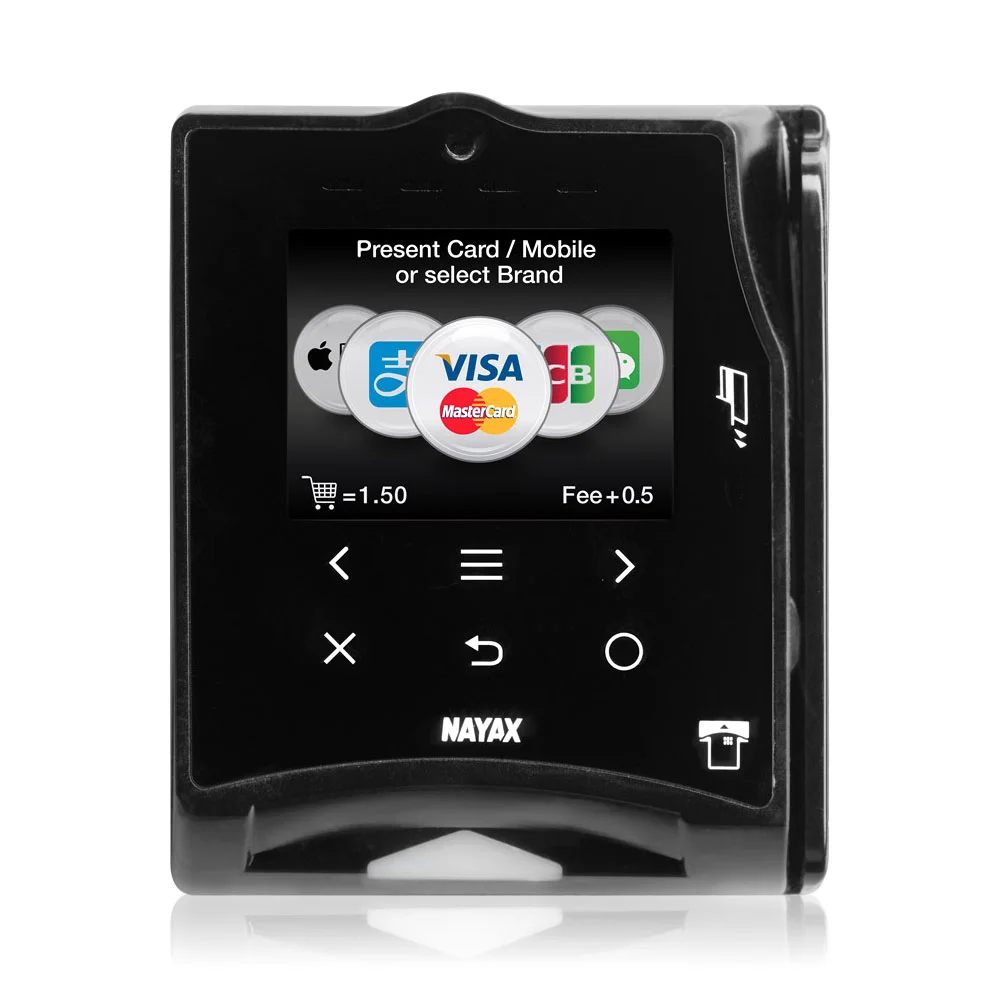
Remote operation and telemetry
What Can a Smart Pizza Vending Machine Monitor Remotely?
Remote management is one of the most valuable features in modern vending infrastructure. The exact functions depend on the machine, payment, and telemetry integration, so buyers should compare actual capabilities rather than relying on the word “smart.”
Inventory
Supported systems can show product maps, stock quantities, and inventory dashboards so operators can plan replenishment before visiting a location.
Temperature alerts
Temperature probes can support configurable alerts when readings move outside expected thresholds. An alert supports—but does not replace—the operator’s corrective-action procedure.
Sales and transactions
Operators can review machine-level sales and transaction information instead of relying only on physical site checks.
Machine and device status
Connected systems can surface device information and alerts that help distinguish stock, payment, connectivity, and machine problems.
Remote price management
Some vending-management platforms allow product or category prices to be changed remotely when the integration supports it.
Fleet management
Remote tools become more useful as the number of machines grows because operators can compare locations and prioritise replenishment or service visits.
A technical question buyers often forget
What Happens If the Internet Connection Goes Down?
There is no single answer for every pizza vending machine. Payment terminals, acquiring rules, telemetry platforms, and machine software can behave differently when connectivity is lost. Some local machine functions may continue while network-dependent payments, dashboards, or alerts are interrupted.
Automation still requires physical care
Which Parts Need Cleaning and Maintenance?
The manufacturer’s instructions should define the actual schedule. Before buying, however, an operator should understand what types of work will remain part of routine ownership.
Food-contact and collection areas
Preparation surfaces, storage access, transfer points, oven areas and pickup compartments may require cleaning depending on the machine design.
Mechanical transfer components
Motors, guides, trays, conveyors, lifts and sensors need to remain aligned and unobstructed for reliable product movement.
Cooling and ventilation
Fans, filters, condenser areas, and airflow paths need maintenance according to the technical instructions and installation environment.
Payment and touchscreen hardware
Customer-facing electronics require cleaning, inspection, and support when communication or transaction errors occur.
Software and connectivity
Configuration, SIM/data service, remote access, and software updates can form part of the maintenance plan without a mechanical failure.
Food-program validation
If the pizza recipe, supplier, diameter, thickness, weight, or storage condition changes, the cooking result should be checked again.
Technical due diligence before ordering
What Should a Commercial Buyer Verify?
A serious specification discussion should move beyond screen size and headline capacity. The whole system must work with your food, location, payments,s and operating routine.
Food workflow
- Fresh dough, refrigerated or frozen?
- Required storage conditions?
- Pizza diameter, thickness and weight limits?
- What testing is required before launch?
Cooking system
- What heating technology is used?
- Can programs differ by pizza?
- How is the product validated?
- What happens after an oven fault?
Remote operation
- Which data is visible remotely?
- Which alerts can be configured?
- Can prices be managed remotely?
- What happens if connectivity is lost?
Payments
- Which terminal and acquirer?
- Which cards and wallets?
- What merchant fees apply?
- How are failed transactions and refunds handled?
Serviceability
- Which panels need technician access?
- Which parts can an operator replace?
- What remote diagnostics are available?
- How are spare parts supplied?
Documentation
- Exact model identity?
- Technical sheet and power requirements?
- Applicable conformity documentation?
- Cleaning and maintenance instructions?
Common technical questions
Pizza Vending Machine Technology FAQ
How do pizza vending machines work?
Most machines accept an order and payment, identify the selected product, retrieve or prepare it, run a programmed cooking or heating cycle, move the finished pizza into a pickup area and update the transaction and stock record.
Do pizza vending machines make pizza from scratch?
Some systems include dough preparation inside the machine. Others hold prepared pizzas under refrigeration or freezing and bake or heat them after the customer orders.
Are pizzas refrigerated or frozen inside the machine?
Both designs exist. Refrigerated fresh-bake machines hold prepared chilled products; frozen stock-and-bake machines maintain frozen inventory; true fresh-dough systems may store ingredients or refrigerated dough components.
What type of oven does a pizza vending machine use?
It depends on the design. Commercial systems can use convection, infrared, microwave-assisted heating, or proprietary combinations. Buyers should confirm the exact model’s oven technology.
How does the machine know which pizza to retrieve?
The controller maps customer selections to storage positions and activates the relevant handling mechanism after the order is approved.
Can a pizza vending machine monitor temperature remotely?
Supported connected systems can use temperature probes and configurable alerts. Exact monitoring and notification functions depend on the machine and telemetry integration.
Can operators see stock remotely?
Many modern vending-management platforms provide product maps, inventory information or stock dashboards. Verify that the quoted pizza machine supports the required integration.
Can prices be changed remotely?
Some connected vending-management systems support remote product or category price changes. Availability depends on the payment and machine integration.
Does a pizza vending machine work without internet?
The answer is configuration-specific. Some local machine functions may continue while payment, cloud reporting, or alerts can be affected. Buyers should ask for the exact offline behaviour in writing.
How quickly does a pizza vending machine cook pizza?
Cooking times vary by machine and product. Let’s Pizza currently states a three-minute preparation time for its system, while other technologies use different programs. The correct cycle depends on the exact food and oven.
How many pizzas can a machine hold?
Capacity is model- and product-dependent. Vendo Pizza’s current commercial families span nominal capacities from 60 to 130 pizzas, while usable capacity can depend on pizza and packaging dimensions.
What makes a pizza vending machine “smart”?
A connected system can add functions such as inventory reporting, transaction data, temperature monitoring, alerts and remote device management. Compare actual functions rather than relying only on the label “smart.”
Do pizza vending machines use AI?
The core transaction, retrieval, temperature and cooking functions can be handled by conventional programmed automation. Some platforms may add analytics or AI features, but buyers should ask what the feature actually does.
What happens if the machine detects a fault?
The response depends on the fault and control logic. A machine may stop a transaction, disable a product, generate an alert,t or require operator or service intervention.
Can I use my own pizza recipe?
Potentially, depending on the machine. The pizza must be compatible with storage, handling, ng and cooking requirements and should be tested for diameter, thickness, weight, packaging, and cooking performance before launch.
Primary technical references
Sources and Further Reading
These external references support the general technical explanations in this guide. Exact Vendo Pizza specifications should still be confirmed in the written quotation and documentation for the selected machine.
- Let’s Pizza — Our Machine Current model-generation comparison, dough workflow, IoT, interface, and preparation information.
- Nayax — Vending Payment and Management Features Product maps, inventory dashboards, temperature/machine/stock alerts, transaction monitoring and remote price management.
- EUR-Lex — Regulation (EC) No 852/2004 on the Hygiene of Foodstuffs Food-business responsibility, temperature control and cold-chain principles.
Understand the Technology Before You Compare Prices
The best machine is not simply the one with the longest features list. It is the configuration that can store your pizza correctly, cook it consistently, accept payments reliably, fit the proposed site, and be supported by an operating routine your team can maintain.