Forecourts · Convenience retail · Service areas · EV charging hubs
Pizza Vending Machines for Petrol Stations & Convenience Stores
Add an unattended hot-food option to petrol stations, gas stations, convenience stores, travel centres and EV-charging locations. Compare Fresh and Frozen Vendo Pizza machines, capacities from 60 to 130 pizzas, indoor and outdoor configurations, cashless payments and the site-safety checks that should happen before installation.
Can a pizza vending machine work at a petrol station?
Yes, when the site is planned correctly. Petrol stations can be strong candidates because customers already stop for fuel, charging, convenience shopping or travel breaks, and many sites operate beyond normal restaurant hours. The critical difference from an ordinary outdoor location is forecourt safety: the proposed machine position must be checked against the station’s hazardous-area plan, vehicle movement, customer circulation, utilities, lighting, security and service access before installation.
Why forecourt retail is a distinct use case
Extend the Hot-Food Offer Without Building a Full Kitchen
A pizza vending machine can complement a convenience store rather than replace it. The strongest use case is where the site already has regular customer stops but hot food becomes limited during late, early, weekend or low-staff periods.
Convenience-store extension
Offer a hot meal alongside drinks, snacks and travel essentials without turning the retail store into a fully staffed pizzeria.
Extended-hour availability
The machine can support food availability when a kitchen counter or store has reduced staffing, subject to safe customer access and the operating plan.
Single site or chain rollout
Start with one forecourt or plan repeatable machine, payment, branding and replenishment standards across several service stations.
Customers already have a reason to stop
Fuel, rest breaks, charging and convenience purchases create dwell time. The relevant commercial question is whether enough of those visitors need a hot meal at the times your current food offer is limited.
Food sales can continue outside kitchen hours
A machine may extend the hot-food window without extending a staffed kitchen shift. It still requires stock, cleaning, food controls, maintenance and fault response.
EV charging creates a different customer journey
Charging customers often remain on site longer than fuel-only customers. Evaluate actual charger usage, dwell time, seating, toilets, lighting and nearby food before assuming demand.
Forecourt safety comes before the machine sale
Do Not Assume a Standard Pizza Vending Machine Can Be Placed Beside Fuel Pumps
Petrol stations can contain hazardous areas where flammable vapour may form an explosive atmosphere. EU workplace rules require hazardous places to be classified into zones according to how often and how long an explosive atmosphere may occur.
Check the station’s hazardous-area classification before choosing the final machine position.
Standard commercial pizza vending equipment should not be assumed suitable for a Zone 0, Zone 1 or Zone 2 area. Where potentially explosive atmospheres may occur, electrical and non-electrical equipment must be selected for the actual classified zone and operating conditions. A pizza-vending project should therefore be positioned only after the petrol-station operator and appropriately qualified electrical/safety professionals have reviewed the site.
Fuel dispensers
Do not select a vending position merely because it is visually close to the pumps. Use the forecourt’s hazardous-area drawing and competent safety review.
Tank vents and filling points
Storage-tank vents, tanker unloading areas and fuel-handling equipment can influence hazardous-zone boundaries. Review them before fixing an outdoor machine location.
Vehicle movement
An otherwise non-hazardous area can still be a poor vending location if reversing vehicles, tankers or customer queues create collision or pedestrian risk.
This page provides project-planning guidance, not a hazardous-area classification or engineering approval. The site operator’s current safety documentation and competent professionals control the final placement decision.
Two common deployment patterns
Inside the Convenience Store or Outside on the Site?
The strongest position depends on customer access, store opening hours, security, utilities and the hazardous-area plan. The machine does not need to sit next to a fuel dispenser to benefit from forecourt traffic.
Indoor / Store-Side Placement
Often easier where the store has suitable space and operating hours align with the food-service objective.
- Reduced direct weather exposure
- Existing CCTV and customer supervision may help
- Power and network routes may be easier to organise
- Staff can notice stockouts or customer problems sooner
- Machine can sit near seating or the existing food area
- Confirm aisle width, fire routes and accessibility
Outdoor / Parking or EV-Side Placement
Can support access when the shop is closed or create stronger visibility, but outdoor installations require more site engineering.
- Hazardous-area review before placement
- Weather, ambient temperature and solar exposure check
- Vehicle-impact protection such as suitable barriers where required
- Drainage, lighting and slip-resistant customer access
- Secure electrical and communications installation
- Safe service and replenishment access away from traffic conflicts
Interactive first-pass site check
Forecourt Site-Readiness Planner
Use this tool to identify the next planning step. It does not approve a petrol-station location or replace the site’s hazardous-area assessment.
Describe the proposed position
Indoor site review
Confirm floor space, access route, power, ventilation, payment connectivity, customer circulation and food-operator workflow.
Current Vendo Pizza commercial range
Fresh and Frozen Pizza Vending Machines for Forecourt Retail
Choose the operating model that fits your existing food business. The right machine is determined by production capability, replenishment distance, location conditions, required capacity and how many sites you plan to operate.
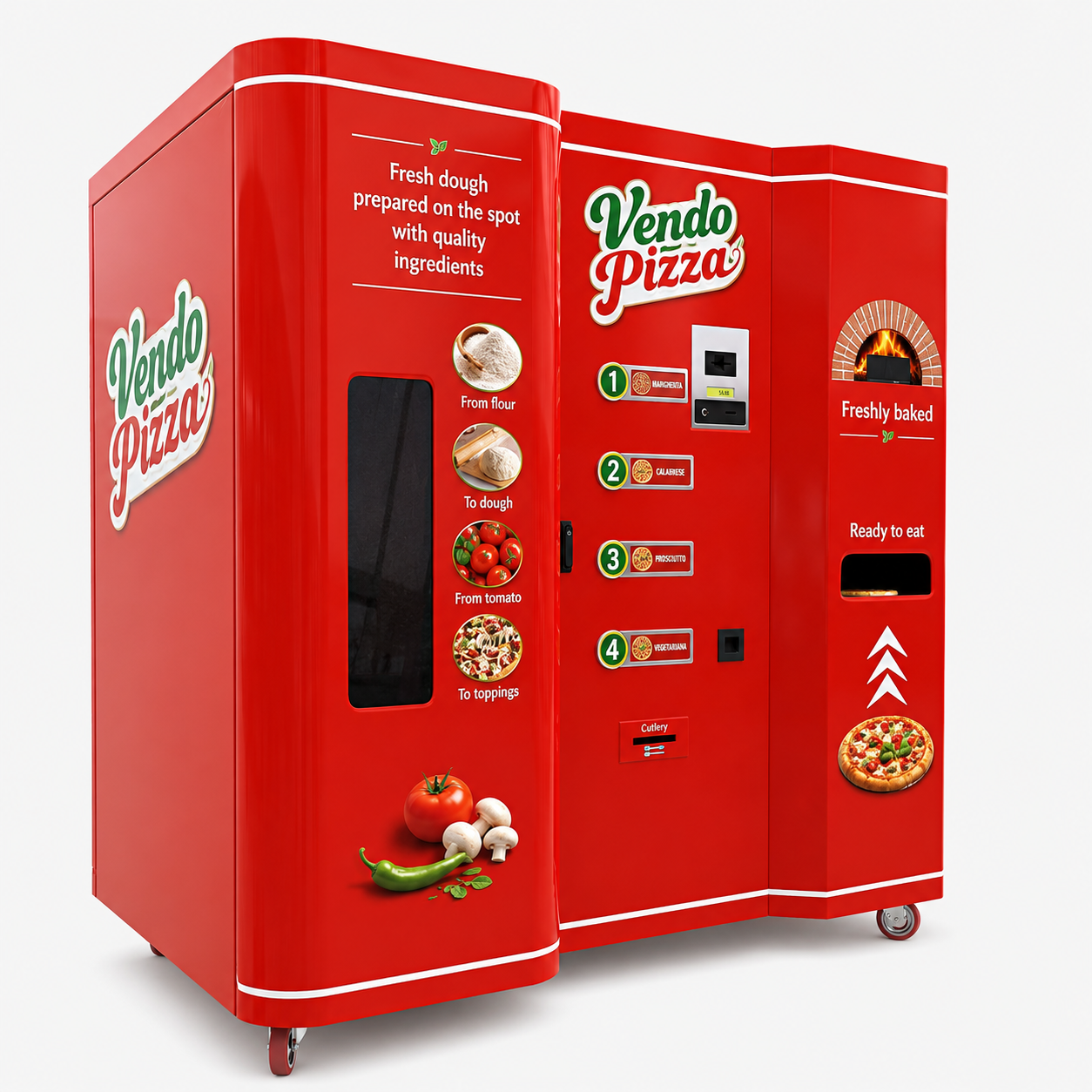
Fresh / Refrigerated Fresh-Bake
Best considered where the operator already has suitable food preparation, a pizzeria or production partner, and can support the more involved cleaning and replenishment workflow.
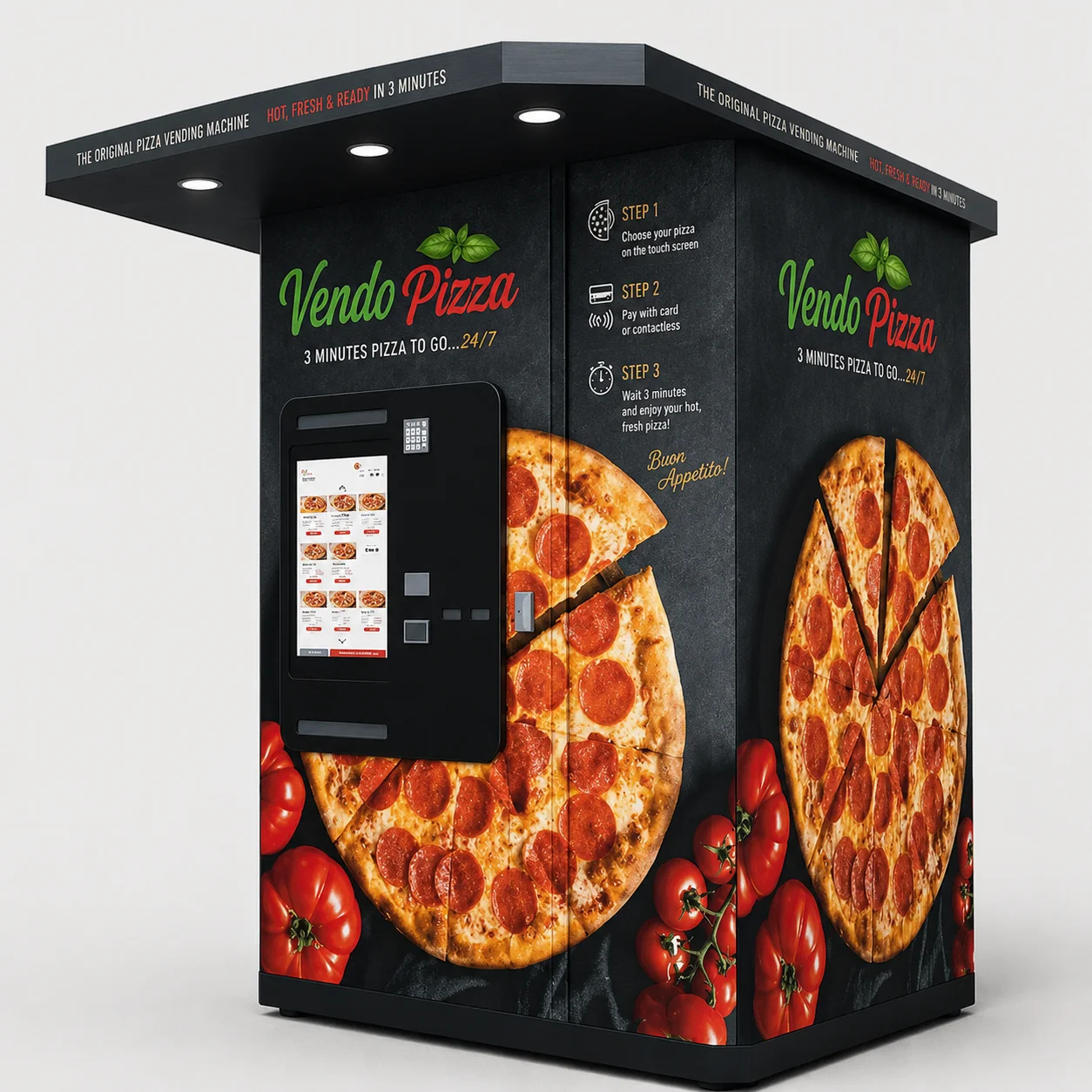
Frozen Stock-and-Bake
Often the simpler operating model for convenience-store groups, service stations and first-time operators using prepared pizzas and repeatable replenishment procedures.
| Model | Capacity | Indoor starting price | Outdoor starting price | Typical planning consideration |
|---|---|---|---|---|
| Fresh 60 | Up to 60 pizzas | €16,000 | €18,000 | Lower-capacity fresh operation |
| Fresh 80 | Up to 80 pizzas | €18,000 | €20,000 | Moderate-demand fresh sites |
| Fresh 100 | Up to 100 pizzas | €20,500 | €22,500 | Higher stock requirement |
| Fresh 120 | Up to 120 pizzas | €23,000 | €25,000 | High-capacity fresh operation |
| Fresh 130 | Up to 130 pizzas | €24,500 | €26,500 | Maximum current Fresh capacity |
| Frozen 60 | Up to 60 pizzas | €7,500 | Site-specific quote | Entry / pilot configuration |
| Frozen 80 | Up to 80 pizzas | €9,000 | Site-specific quote | Moderate-demand prepared-pizza site |
| Frozen 100 | Up to 100 pizzas | €10,500 | Site-specific quote | Higher replenishment interval |
| Frozen 120 | Up to 120 pizzas | €12,500 | Site-specific quote | Maximum current Frozen capacity |
Prices are starting prices for base machines. Final price depends on the selected machine identity, cabinet, oven, payment hardware, software/connectivity, branding, outdoor protection, quantity, freight destination, installation and site works. VAT and local taxes are excluded unless stated in the quotation.
A growing forecourt customer journey
Pizza Vending at EV Charging Hubs
EV charging can create a longer visit than a fuel-only stop, but dwell time alone does not guarantee food sales. Evaluate the actual charger utilisation, charging duration, customer amenities and nearby food offer before choosing capacity.
Use real charger data
Review sessions per day, average dwell time, overnight usage and seasonal variation rather than assuming every charger customer will buy food.
Build a comfortable stop
Lighting, shelter, seating, toilets and a clear pedestrian route can matter as much as machine visibility when customers remain on site for a charging session.
Keep service routes separate
Plan restocking and technician access so vans, trolleys and open service doors do not conflict with charging bays or customer walking routes.
Fast transactions and remote visibility
Payments, Connectivity and Multi-Site Monitoring
Forecourt buyers should treat payments and connectivity as part of the operating system, not an afterthought. The exact terminal, merchant account, acquirer, card schemes, fees and remote-management features depend on the selected configuration and country.
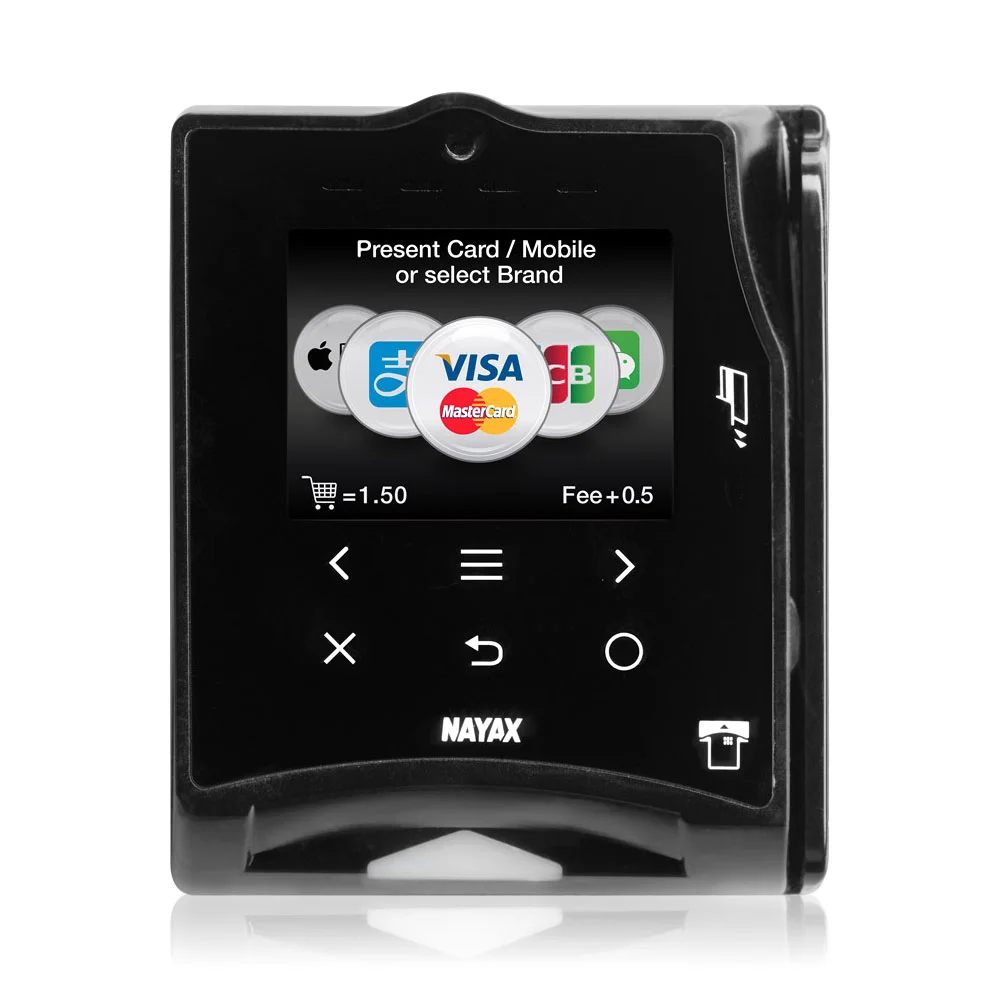
Customer payments
Supported configurations can accept card, contactless and mobile-wallet payments. Confirm settlement currency, transaction charges, refunds and chargebacks with the payment provider.
Connectivity
SIM/mobile data, Wi-Fi or Ethernet may be used depending on the site. Define what happens if connectivity fails and how payment or machine alerts are handled.
Remote oversight
Available configurations may expose sales, inventory, temperature, payment-terminal status, connectivity and machine alerts. Confirm the exact dashboard functions in writing.
Who owns each part of the operation?
Restocking, Food Safety and Forecourt Responsibilities
A 24/7 machine is not maintenance-free. Define responsibilities before launch so there is no confusion over food production, replenishment, hygiene, payment issues, customer refunds or technical faults.
Property and forecourt controls
Approve the location, provide or approve utilities, coordinate hazardous-area and vehicle/pedestrian safety, control site access and define any landlord or brand requirements.
Daily commercial operation
Own the food workflow, stock rotation, temperature records, allergen information, cleaning, replenishment, merchant account, customer service and routine operator checks.
Machine and project scope
Supply the quoted machine/configuration and the applicable technical documentation, commercial terms, warranty scope, remote assistance process and destination-specific support agreed in writing.
Restocking plan
- Define delivery frequency from real sales and capacity
- Protect the cold chain during transport and loading
- Use stock rotation and expiry controls
- Prevent restocking during unsafe peak vehicle movements
Hygiene plan
- Document cleaning and sanitising responsibilities
- Keep required food and allergen information current
- Record food temperatures as required by the operating system
- Respond to refrigeration or food-safety alarms promptly
After-hours response
- Decide who receives faults and payment alerts
- Define customer refund handling
- Keep technician access compatible with forecourt security
- Plan safe shutdown or restricted operation when needed
Budget the whole forecourt project
Machine Price Is Only One Part of the Petrol-Station Project Cost
A credible budget separates the base machine from the forecourt-specific work needed to make the location safe, accessible and serviceable.
Machine and commercial options
Base machine, capacity, screen/software, cashless payment hardware, connectivity, branding and optional equipment.
Forecourt site works
Electrical work, network routes, concrete/base works where required, drainage, lighting, barriers/bollards, signage and customer access improvements.
Logistics and commissioning
Export packaging, freight, unloading equipment, site access, installation labour, commissioning and any local inspections or contractors.
Do not use a generic “installed price” from another country or another forecourt as the budget for your own site. The accepted quotation should identify exactly what is included and excluded.
A safer commercial buying sequence
How to Plan a Petrol-Station Pizza Vending Project
Complete site and safety checks before committing to an exact outdoor configuration. This avoids buying the machine first and discovering that the intended position cannot be approved.
Define the business objective
Decide whether the machine supplements the shop, extends food hours, serves EV charging, or forms part of a multi-site retail rollout.
Shortlist the position
Identify indoor or outdoor candidate areas with safe pedestrian access, utilities, visibility and service access.
Clear the forecourt safety gate
Review hazardous-area classification, fuel infrastructure, tank delivery routes, traffic and vehicle-impact risk with competent site professionals.
Choose Fresh or Frozen
Select the food workflow and capacity using production capability, expected demand, storage and replenishment frequency.
Confirm equipment and quotation
Review machine identity, payment hardware, outdoor package, price, delivery basis, warranty and documentation before purchase.
Prepare and commission
Complete approved site works, merchant onboarding, food procedures, staff/operator training and launch checks before public operation.
Continue the project review
Useful Vendo Pizza Guides for Forecourt Buyers
Installation & Setup
Power, access, ventilation, connectivity, outdoor exposure and service clearance.
Review installation → DocumentationCertifications & Compliance
Verify the exact model identity, technical data and applicable conformity documentation.
Review documentation → Operations24/7 Pizza Vending
Plan unattended payments, stock, monitoring, fault response and extended-hour operation.
Review 24/7 operation → Due diligence25 Questions Before Buying
Use a structured checklist before accepting a machine quotation or committing to a site.
Open the checklist →Questions from petrol and convenience retailers
Pizza Vending Machines for Petrol Stations: Frequently Asked Questions
Answers below are general planning guidance. The final forecourt position, equipment, installation and operating responsibilities must be verified for the specific site.
Can a pizza vending machine be installed at a petrol station?
Yes. The machine can be used at petrol stations, gas stations, service areas and convenience stores when the location has suitable customer access, power, food-operation procedures and safe positioning. Outdoor projects also require environmental and forecourt-specific review.
Can the machine be installed next to fuel pumps?
Do not assume so. Petrol stations may contain ATEX-classified hazardous zones around fuel-handling equipment. Standard commercial vending equipment should not be placed in a classified zone unless the complete equipment is specifically suitable and approved for that zone. Review the station’s hazardous-area plan with competent professionals first.
Does a pizza vending machine need ATEX certification at a petrol station?
That depends on where the equipment is installed. ATEX equipment requirements apply to equipment intended for use in potentially explosive atmospheres. The preferred strategy for a normal commercial pizza vending machine is to select a location that the station’s competent safety review confirms is appropriate for that equipment, rather than assuming it can operate inside a hazardous zone.
Where should the machine be positioned on a forecourt?
Consider the store entrance, indoor retail area, parking/customer zone, EV charging area or another site-approved non-hazardous position. The location should also provide safe pedestrian access, adequate utilities, visibility, lighting, weather protection where needed, and convenient restocking/service access.
Can a pizza vending machine operate outdoors?
Yes, outdoor configurations are available. The exact cabinet, environmental protection, temperature range, rain exposure, ventilation, drainage, security, electrical protection and service access must be confirmed for the selected model and site.
How much does a pizza vending machine for a petrol station cost?
Frozen indoor machines start from €7,500 for the 60-pizza configuration. Fresh machines start from €16,000 indoor and €18,000 outdoor. Final forecourt project cost can also include payment hardware, outdoor equipment, freight, electrical/site work, barriers, installation and local taxes.
Is Fresh or Frozen better for convenience stores?
Frozen often provides the simpler workflow for retailers using prepared pizzas and repeatable multi-site stock control. Fresh can suit premium food concepts or operators with suitable kitchen/production capability. Neither format is automatically more profitable.
Can convenience-store staff restock the machine?
Potentially, if the operator’s food-safety procedures, training, stock rotation, temperature controls and machine instructions assign that responsibility to them. The commercial and food-business roles should be agreed before launch.
Can it operate when the convenience store is closed?
It can be planned for extended or 24/7 access when the machine position remains safely accessible, monitored and serviceable outside store hours. Security, lighting, payments, stock, fault response and customer access must all be considered.
Which payment methods can it accept?
Supported configurations can use card, contactless and mobile payments. Exact terminal, acquirer, card schemes, wallet support, currency, connectivity, transaction fees and merchant-account responsibilities depend on the country and payment provider.
Does the machine need Wi-Fi?
Not necessarily. Depending on the configuration, connectivity may use SIM/mobile data, Wi-Fi or Ethernet. The project should also define how payments, monitoring and fault handling behave if the connection is interrupted.
What capacity should a busy petrol station use?
Do not size the machine from a generic “busy site” label. Use actual food demand, opening hours, night traffic, EV-charging usage, replenishment frequency, storage capacity and nearby competition. The Fresh range offers 60–130 pizzas; Frozen offers 60–120.
Can pizza vending work at an EV charging station?
Yes, it can be considered where charger customers have meaningful dwell time and limited nearby hot-food options. Evaluate actual charging sessions, lighting, customer amenities, outdoor exposure and safe pedestrian/service routes before choosing capacity.
Who is responsible for food safety?
The food-business operator is responsible for the food activity and applicable hygiene, traceability, temperature, allergen and consumer-information duties. Vendo Pizza supplies the quoted machine and applicable machine documentation; it does not replace the operator’s local food-safety responsibilities.
Can I buy one machine for a pilot site?
Yes. One-unit enquiries are accepted. A pilot can help the buyer validate the site, food workflow and replenishment process before considering a multi-site rollout, but no sales or payback result is guaranteed.
Can a petrol-station chain order multiple machines?
Yes. Multi-site projects can be planned around a consistent machine family, capacity strategy, payment platform, branding and replenishment process, while still reviewing the hazardous-area and installation conditions separately for each forecourt.
Plan a Pizza Vending Project for Your Petrol Station or Convenience Store
Send the country and city, site type, proposed machine position, Fresh or Frozen preference, required capacity, indoor or outdoor plan and number of locations. We will prepare a configuration-based commercial quotation after the forecourt requirements are clear.