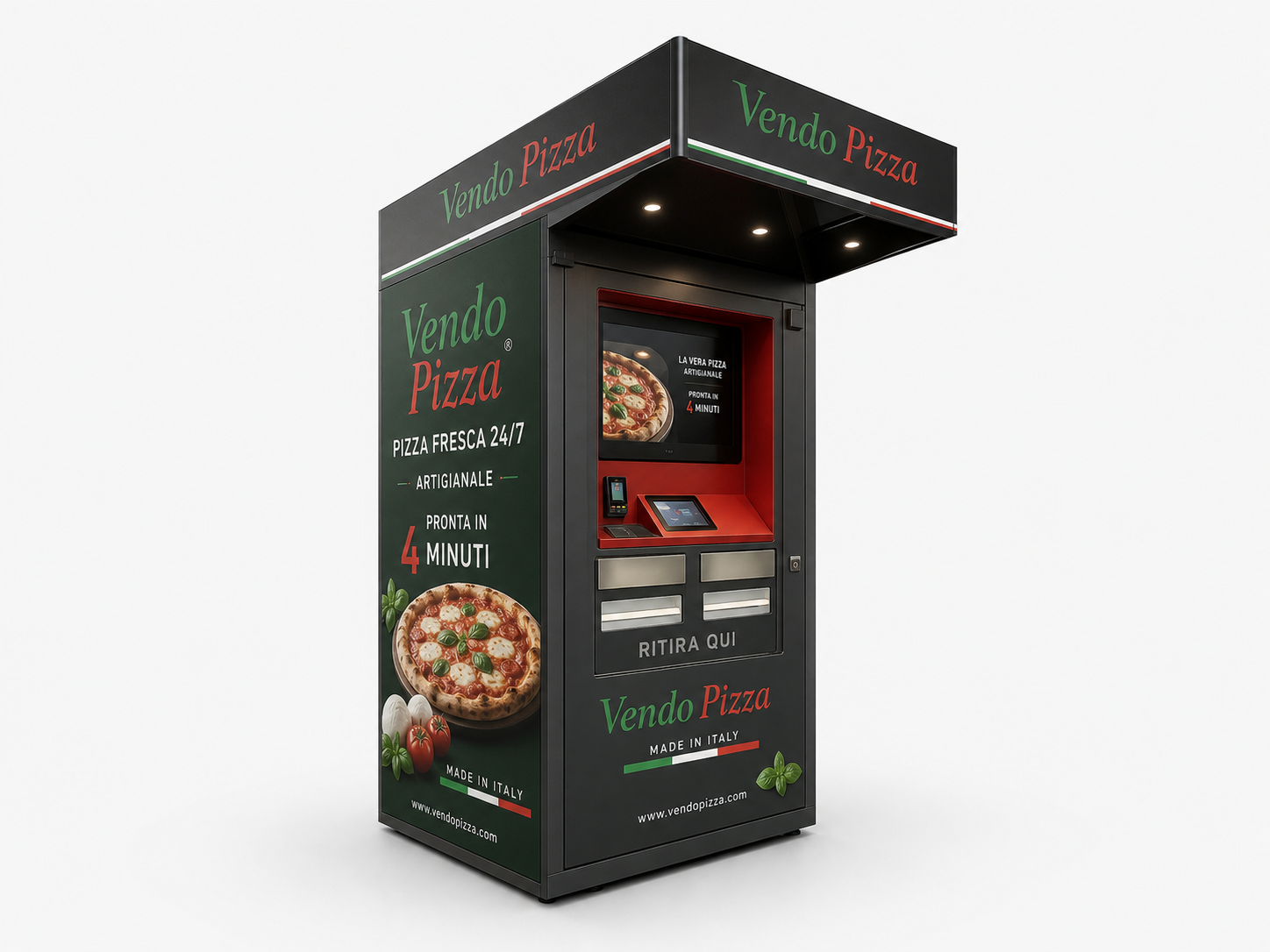
Pizza vending machines are attracting increasing attention in the UK as food operators, property owners and entrepreneurs look for new ways to provide convenient hot food without relying entirely on the operating model of a conventional takeaway.
The appeal is not simply the vending machine itself. Pizza vending sits at the intersection of several broader developments in food retail: demand for convenience, extended-hours food availability, automation, unattended retail and the search for more flexible ways to serve customers.
At the same time, a pizza vending machine is not a shortcut to a successful food business. Location, product, pricing, replenishment, food-safety controls, machine uptime and operating costs all influence whether a particular installation makes commercial sense.
So why are pizza vending machines becoming more interesting in the UK? And what does the trend actually mean for someone considering investing in a machine?
Why the UK market is paying attention
- Convenience: Automated food retail can bring hot food closer to customers in locations where a traditional restaurant may not be practical.
- Extended availability: Vending can support food sales beyond conventional restaurant opening hours.
- Automation: Technology can reduce the amount of staff involvement required at the point of each individual transaction.
- Pizza fits the format: Standardised recipes, repeatable preparation and familiar customer expectations make pizza well suited to automated food production.
- New locations: Machines can potentially serve residential, leisure, travel, education and other high-footfall environments outside traditional high streets.
- Flexible operating models: A vending machine can complement an existing food business or form part of a standalone unattended-food operation.
What Is Driving the Growth of Pizza Vending Machines in the UK?
There is no single reason for the increased interest in pizza vending machines. Instead, several trends are converging.
Consumers increasingly expect convenient purchasing, while food operators face the practical realities of staffing, opening hours, premises costs and operational complexity. Automated food retail offers another way of structuring the customer journey.
The UK also already has an established vending environment. The Food Standards Agency recognises vending machines within its food-business registration framework, while its food-hygiene guidance covers core requirements such as cooking, cleaning, chilling and preventing cross-contamination.
Pizza vending should therefore not be viewed as completely separate from food retail. It is better understood as an evolution of unattended retail into a product category where customers normally expect freshly prepared, hot food.
1. Consumers Want Convenience Without the Traditional Restaurant Journey
One of the strongest arguments for automated food retail is simple: customers do not always want to enter a restaurant, wait for a kitchen to prepare an order or travel to a town-centre takeaway.
A strategically placed pizza vending machine can shorten that journey.
The customer can discover the machine, select a pizza, pay digitally and collect the finished product from the same location. For certain sites, that simplicity can be more important than having a large menu or a traditional dining environment.
This is particularly relevant in locations where customers already have a reason to stop: residential developments, petrol stations, student accommodation, leisure venues, holiday parks, business locations and other destinations with regular footfall.
The important distinction
A pizza vending machine does not create customer demand by itself. Its commercial value comes from placing a suitable food product in front of an existing or identifiable customer base at a convenient time and location.
2. The 24/7 Food Concept Is Changing What a “Food Location” Can Be
Traditional restaurants and takeaways are constrained by opening hours, staffing and the economics of keeping a kitchen operating during quieter periods.
An automated pizza machine creates another possibility: making food available for significantly longer periods without operating a conventional dining room or full takeaway kitchen.
This is particularly interesting for sites where demand does not stop when traditional food outlets close.
Think about a student accommodation site late at night, a holiday park between meal periods, a petrol station on a long-distance route or a residential development where the nearest takeaway may be several miles away.
The opportunity is not necessarily “open every machine 24 hours and forget about it.” The machine still requires replenishment, cleaning, monitoring and maintenance. The advantage is that the customer-facing sales process can operate for much longer than a conventional staffed counter.
3. Labour Efficiency Is Increasing Interest in Automation
Labour is an important consideration for any food-service business.
Food and hospitality businesses require people across preparation, service, cleaning, management and other operational functions. For some operators, automation is therefore being considered as a way to restructure how staff time is used rather than simply as a way to eliminate jobs.
Pizza vending machines do not eliminate labour.
Operators still need people to replenish machines, clean equipment, manage ingredients, respond to faults, perform maintenance and oversee the wider business.
The difference is that automation can change where and when labour is required.
Instead of having an employee standing behind a counter for every hour that food is available, some of the customer transaction and food-production process can be handled by the machine.
For the right site, that can create a different cost structure from a traditional takeaway.
4. Pizza Is Particularly Suitable for Automated Food Preparation
Not every food product is equally easy to automate. Pizza has several characteristics that make it a natural candidate for vending and automated preparation.
- Recipes can be standardised.
- Portions can be controlled.
- Cooking can follow repeatable programmed cycles.
- Customers already understand the product.
- A relatively small menu can still provide meaningful variety.
- Different topping combinations can be built around a consistent base product.
- Pizza is already strongly associated with takeaway and delivery.
This standardisation matters because automation works best when the product can be produced consistently within defined technical parameters.
That does not mean every pizza recipe will work in every machine. Dough characteristics, cheese, sauces, toppings, portion sizes, storage conditions and cooking profiles all need to be compatible with the equipment.
5. Pizza Vending Can Put Food in Locations That Do Not Suit a Traditional Takeaway
One of the most interesting changes created by vending is the ability to consider locations that would not normally support a full restaurant.
Potential sites include:
- Student accommodation
- Residential developments
- Petrol stations and service locations
- Holiday parks
- Hotels and hospitality sites
- Business parks
- University environments
- Leisure and entertainment venues
- Private commercial sites
- High-footfall transport-related locations
The important question is not whether a site “looks busy.” The question is whether it contains enough of the right customers at the right times and whether the site economics allow the machine to operate profitably.
6. Unattended Retail Is Becoming More Sophisticated
Modern vending is very different from the simple snack machine many people remember.
Digital payments, remote monitoring, connected equipment, inventory management and automated alerts can give operators greater visibility over machines without being physically present at every transaction.
For pizza vending, that technology can be especially valuable because the machine may need to monitor operational conditions as well as sales and stock.
Depending on the machine and configuration, an operator may be able to monitor information such as sales, inventory, temperature or machine status remotely.
That creates the possibility of managing multiple machines as a network rather than treating every location as a separate staffed food outlet.
7. Digital Payments Make the Customer Journey Faster
A modern pizza vending machine needs to make purchasing simple.
Customers are increasingly comfortable using contactless and digital payment methods for everyday purchases. For unattended food equipment, a fast payment process is particularly important because the customer should not need to interact with staff.
For operators, payment technology can also connect transactions with remote reporting and machine-management systems.
When evaluating a machine, however, payment functionality should be considered as part of the total system rather than treated as a small accessory. Ask about transaction fees, payment hardware, connectivity, software charges, installation and ongoing support.
8. Pizza Vending Can Extend an Existing Food Brand
A pizza vending machine does not have to replace a restaurant or takeaway.
For an existing pizza business, vending can potentially become an additional distribution channel.
A restaurant might use a machine to reach a residential development that is too far from the main premises. A pizza brand could use vending to extend its geographic presence without opening a complete second restaurant. An operator could also use multiple machines to test demand in different locations.
The business model therefore can sit somewhere between traditional food service and retail distribution.
9. Fresh and Frozen Pizza Vending Offer Different Operating Models
Not all pizza vending machines work in the same way.
Broadly, buyers may encounter frozen stock-and-bake systems and fresh preparation or fresh-bake systems.
A frozen workflow can simplify product storage and loading by using prepared pizzas that are held frozen and cooked to order.
A fresh system can provide a different customer proposition and potentially greater flexibility around preparation and recipes, but it can also introduce additional requirements around ingredients, refrigeration, cleaning and food handling.
Neither model is automatically right for every location. The correct choice depends on the operator's supply chain, menu, expected demand, staffing, site and desired level of food preparation.
Explore the two Vendo Pizza categories: Frozen Pizza Vending Machines and Fresh Pizza Vending Machines .
10. The Economics Can Be Different From a Conventional Takeaway
One reason entrepreneurs investigate pizza vending is the possibility of operating a food-sales point without the full infrastructure of a conventional restaurant.
A traditional takeaway can involve premises, kitchen equipment, front-of-house space, multiple employees, longer opening-hour staffing and significant fixed overheads.
A vending installation has a different cost structure.
But lower operating complexity does not mean zero operating cost.
Key costs to include in a UK pizza vending business model
- Machine purchase or finance cost
- Shipping and installation
- Electrical or site preparation
- Pizza ingredients and packaging
- Payment processing
- Software and connectivity
- Electricity
- Site rent or revenue share
- Replenishment labour
- Transport to and from the machine
- Cleaning and sanitation
- Maintenance and spare parts
- Insurance and other business costs
- Food waste and unsold stock
The key metric is therefore not simply the machine's purchase price. It is the relationship between sales volume, gross margin, operating costs and capital invested.
11. Why Location Is More Important Than the Machine
This is one of the most important principles for anyone considering the UK pizza vending market.
A technically excellent machine can perform poorly in the wrong location.
Conversely, a well-matched machine in a strong location can have a much clearer commercial opportunity.
Before ordering equipment, investigate:
- How many potential customers pass the site?
- When does traffic peak?
- Are customers already buying food nearby?
- How far is the nearest competing takeaway?
- Is there evening or overnight demand?
- Can customers safely stop and access the machine?
- Is parking available where appropriate?
- Does the site have suitable electrical capacity?
- Who owns the land and controls the installation?
- What rent or commission does the site owner require?
The location test
Do not ask only, “Can I put a pizza vending machine here?” Ask, “Why would enough customers buy pizza here, repeatedly, at the price I need to charge?”
12. Outdoor Pizza Vending Creates New Opportunities — and New Requirements
Outdoor installation is one of the reasons vending can reach locations that would be difficult to serve with a conventional food outlet.
But outdoor vending also introduces additional technical considerations.
Weather, temperature, humidity, direct sunlight, security, drainage, electrical protection and customer access all need to be considered.
An indoor machine should not simply be placed outdoors because the cabinet physically fits. The exact machine configuration must be appropriate for the intended environment.
This is particularly important in the UK, where rain, cold temperatures and seasonal weather can create operating challenges for outdoor equipment.
13. Food Safety Still Matters in an Automated Business
Automation does not remove food-safety responsibilities.
The Food Standards Agency provides guidance for food businesses covering areas such as food hygiene, cooking, cleaning, chilling and prevention of cross-contamination. Its registration system also includes vending machines as a business type.
For a pizza vending operation, food-safety planning can involve temperature control, ingredient storage, stock rotation, cleaning, allergen management, food preparation, waste handling and procedures for equipment failures.
Operators should establish the requirements applicable to their specific business and local authority before opening.
A machine being automated does not mean that food-safety management can be automated away.
14. The UK Market Is Not “Set and Forget”
One of the biggest misconceptions about vending is that once the machine is installed, the business operates by itself.
Successful unattended retail still requires active management.
Someone has to ensure that products are available, ingredients are handled correctly, the machine is clean, faults are addressed and the customer experience remains consistent.
Remote monitoring can reduce unnecessary site visits, but it does not replace physical servicing and replenishment.
The real opportunity is therefore not “no labour.” It is using automation to make labour more targeted and scalable.
15. What Could Stop a Pizza Vending Machine From Succeeding?
A credible discussion of the market also needs to consider the risks.
- Poor location: Insufficient demand is difficult to fix with technology.
- Wrong product: A menu that does not match local customers can reduce repeat purchases.
- High site costs: Rent or revenue-sharing arrangements can consume too much margin.
- Low sales volume: Machine capacity does not matter if demand is weak.
- Downtime: A machine that cannot operate cannot generate sales.
- Weak replenishment planning: Stockouts and unnecessary journeys increase operating costs.
- Food-safety failures: Automated equipment still requires robust food-safety procedures.
- Technical mismatch: Insufficient power or unsuitable environmental conditions can create avoidable problems.
- Competition: Nearby takeaways, supermarkets and delivery services can affect demand.
These risks are why due diligence should happen before the machine is ordered.
16. How Much Does a Pizza Vending Machine Cost in the UK?
There is no single UK price because the investment depends on the machine type, capacity, indoor or outdoor configuration, payment technology, shipping, installation and optional equipment.
Buyers should therefore compare the total installed cost rather than only the advertised machine price.
For a detailed breakdown, see our Pizza Vending Machine Cost Guide .
You can also compare the current Frozen Pizza Vending Machine and Fresh Pizza Vending Machine ranges.
17. Can a Pizza Vending Machine Be Profitable in the UK?
It can be commercially viable in the right circumstances, but profitability should be calculated for the individual site rather than assumed from the machine concept.
A useful model starts with daily sales and average selling price, then subtracts the variable and fixed costs required to operate the location.
Build your own financial model
- Estimate realistic pizzas sold per day.
- Calculate average selling price.
- Calculate ingredient and packaging cost per pizza.
- Allow for payment processing fees.
- Estimate electricity and connectivity.
- Include site rent or revenue share.
- Include replenishment labour and transport.
- Allow for maintenance and downtime.
- Include waste and expired stock.
- Calculate monthly operating profit.
- Calculate the sales volume required to break even.
- Test conservative, expected and high-sales scenarios.
This approach is more useful than relying on a generic “pizza vending machine ROI” number because two identical machines can produce very different results in different locations.
18. What Makes the UK Particularly Interesting for Pizza Vending?
The opportunity is ultimately about the combination of several characteristics rather than one national statistic.
The UK has a mature takeaway and convenience-food culture, widespread digital payments, an established vending sector and a large hospitality and food-service workforce. At the same time, operators are continually looking for ways to improve efficiency and serve customers in different locations and time periods.
This combination creates an environment in which automated food retail can be considered alongside more traditional food-service formats.
19. Pizza Vending Is More Than a Vending Machine
The most useful way to think about the business is as a small automated food-service operation.
The machine is the physical platform, but the business also includes:
- The location
- The pizza recipes
- The ingredient supply chain
- Pricing
- Payment technology
- Customer experience
- Replenishment
- Cleaning
- Food-safety management
- Technical support
- Marketing
- Financial management
Thinking about the complete operating system helps explain why two businesses using the same machine can achieve very different results.
20. What Should You Do Before Buying a Pizza Vending Machine?
If you are considering entering the UK pizza vending market, do not begin with the machine catalogue.
Begin with the site.
Identify the customer, estimate demand, investigate competitors, confirm the available power, understand the installation environment and calculate the economics.
Then compare machine configurations against those requirements.
Pre-investment checklist
- Identify the target customer.
- Measure or estimate realistic site traffic.
- Identify peak purchasing periods.
- Map nearby food competitors.
- Confirm site access and security.
- Check electrical requirements.
- Decide between fresh and frozen operation.
- Estimate replenishment frequency.
- Understand food-safety requirements.
- Calculate total installed cost.
- Model conservative and expected sales.
- Compare warranty and technical support.
- Review spare-parts availability.
- Get important commitments in writing.
For a more detailed supplier due-diligence process, read our 25 Questions to Ask Before Buying a Pizza Vending Machine .
Frequently Asked Questions About Pizza Vending Machines in the UK
Why are pizza vending machines becoming more popular in the UK?
Interest is being driven by several factors, including demand for convenience, extended food availability, automation, digital payments and the possibility of serving locations that may not justify a conventional takeaway. The business model can also change how labour is used by automating parts of the customer and food-service process.
Are pizza vending machines actually 24/7?
A machine can potentially make food available beyond traditional restaurant opening hours, depending on its configuration and location. However, 24/7 availability does not mean zero operational work. Machines still require replenishment, cleaning, monitoring and maintenance.
Where can pizza vending machines be installed in the UK?
Potential sites include residential developments, student accommodation, petrol stations, holiday parks, hotels, business parks, universities, leisure venues and other suitable private or commercial locations. The suitability of each site depends on customer demand, access, power, security, permissions and local requirements.
Are pizza vending machines profitable?
Profitability depends on the individual business case. Daily sales, selling price, food cost, site fees, labour, electricity, maintenance, payment fees and machine uptime all affect the result. A supplier's generic ROI example should not be treated as a guarantee for a specific UK location.
Is a pizza vending machine cheaper than opening a takeaway?
The investment structure can be substantially different because a vending installation may require less premises infrastructure and fewer customer-facing staff than a conventional takeaway. However, the machine still involves capital expenditure, installation, food costs, site costs, maintenance and replenishment. The two models should be compared using total cost of ownership rather than headline purchase price.
Do pizza vending machines need staff?
They still require operational management. Staff or contractors may be needed for replenishment, cleaning, food handling, maintenance, customer support and fault resolution. Automation changes the type and timing of labour required; it does not eliminate operational responsibilities.
Are pizza vending machines regulated as food businesses in the UK?
Food businesses must comply with applicable food-safety requirements, and the Food Standards Agency's registration system includes vending machines as a business type. Exact obligations depend on the food operation, local authority and business structure, so operators should establish the requirements that apply to their specific installation before trading.
Is fresh or frozen pizza better for vending?
Neither is universally better. Frozen systems can offer a simpler stock-and-bake workflow, while fresh systems can offer a different preparation model and potentially greater recipe flexibility. The appropriate choice depends on the location, supply chain, menu, expected sales, cleaning requirements and operator capabilities.
What is the most important factor when starting a pizza vending business?
The site and its underlying demand are among the most important factors. A high-capacity machine cannot compensate for insufficient customer demand. Before purchasing equipment, validate the location, customer profile, competitive environment, access, operating costs and expected sales volume.
Conclusion: Why the UK Pizza Vending Opportunity Is Getting Attention
Pizza vending machines are attracting attention in the UK because they combine several powerful ideas: convenience, automation, extended food availability and flexible site deployment.
Pizza itself is also well suited to automated production because the product can be standardised, recipes can be controlled and cooking can follow repeatable processes.
But the strongest opportunity is not simply putting a machine somewhere and waiting for sales.
The real business opportunity comes from matching the right machine, the right pizza, the right location and the right operating model.
For entrepreneurs and food operators considering the UK market, that means starting with demand and site economics rather than the machine catalogue.
Once the business case makes sense, the next step is to compare machine types, capacity, installation requirements, food workflows, costs and supplier support.
Exploring Pizza Vending in the UK?
If you have identified a potential UK location and want to evaluate the equipment options, explore the Vendo Pizza machine ranges and compare the Fresh and Frozen operating models.
Review our Frozen Pizza Vending Machines and Fresh Pizza Vending Machines or request a quotation based on your location, capacity and intended operating model.
Request a Pizza Vending Machine QuotationImportant: This article discusses commercial trends and operating considerations rather than guaranteeing market growth, sales or profitability. Food-safety, planning, electrical, installation and other legal requirements vary according to the specific business, machine, premises and UK jurisdiction. Operators should obtain appropriate professional and local-authority advice before commencing operations.